



Jobs can disappear. Companies can change. Industries can be disrupted. Titles can stop meaning what you thought they were supposed to mean.
It’s possible, even natural, to associate your identity with things that can and do change.
When your identity is attached to things that change, a loss of career can feel like losing part of yourself.
But your career is not your identity. Your intrinsic value does not belong to your employer. It belongs to you.
This includes your natural strengths, your experience, and your judgment. These are uniquely yours. They stay with you wherever you go.
Even AI can’t duplicate your natural strengths (but it can amplify them).
When career identity mixes with actual identity
A 2019 article in the Harvard Business Review by Janna Koretz entitled “What Happens When Your Career Becomes Your Whole Identity” explored a concept called “enmeshment” (what happens when career identity mixes with actual identity).
Life feels comfortable and “good” when things are going well. You feel confident about who you are. You feel like your situation is a good fit. You can see a predictable future ahead.
But when your context changes, things can get uncomfortable fast.
Changing contexts include layoffs, reorganizations, career plateaus, industry changes, or new technology, especially AI.
Others include living with decisions that were made without you, or deciding to leave the work that has defined you for years.
Then, your biggest question isn’t just “What should I do next?”
It’s deeper. It’s “Who am I now?”
That’s a tough one.
But those existential questions become much easier to answer if your identity is portable.
Your Portable Identity
What about your identity do you actually own?
What do you take with you when your situation changes?
It’s not your title, your position on an organizational chart, or even your industry. Those things can come and go rapidly. But you do own certain portable essentials.
You own your natural strengths. These strengths determine how you work when you are free to be yourself, including:
How you gather and share information.
How you organize.
How you deal with risk and uncertainty.
How you work with tangibles.
You also own your experience.
The stories only you can tell.
The situations you have encountered.
The people you have worked with.
The disasters you have survived.
The problems you have solved.
Over time, you developed judgment. You learned to recognize patterns. You can notice things that others don’t. You know how to distinguish signal from noise.
All of these portable qualities persist even when your situation changes.
Context change can feel like starting over
Career change can feel like starting over when context is confused with capability.
Years spent in an industry do not merely equate to years of industry knowledge.
It also includes:
Handling difficult situations.
Explaining complex ideas.
Building relationships.
Making decisions with incomplete information.
Seeing opportunities.
Solving problems.
Learning what works and what does not.
Those capabilities are portable.
Your experience can be applied elsewhere.
Your judgment can be invaluable in a different setting.
Your strengths can express themselves through a wide variety of compatible roles.
The context may change, but your natural strengths do not. You carry them with you.
My Story
Here is my story about how I learned about my natural strengths:
In 2010, I was a regular listener to a podcast called The Small Business Advocate by Jim Blasingame.
I had recently gone independent after almost a decade of digital production in the comics entertainment industry.
That day, Jim’s guest was Kathy Kolbe. I had never heard of her, but soon I realized that I wanted to hear everything that she had to say.
She described volition, instinct, and strengths, and how everyone has their own “MO”, or mode of operation. That MO describes how they will take action when they are free to be themselves.
She introduced me to a new term — conation. Conation differs from the cognitive dimension, such as IQ, or the affective dimension, such as personality. Conation deals with doing.
I found myself calling up her website to take the 15 minute Kolbe A™ Assessment.
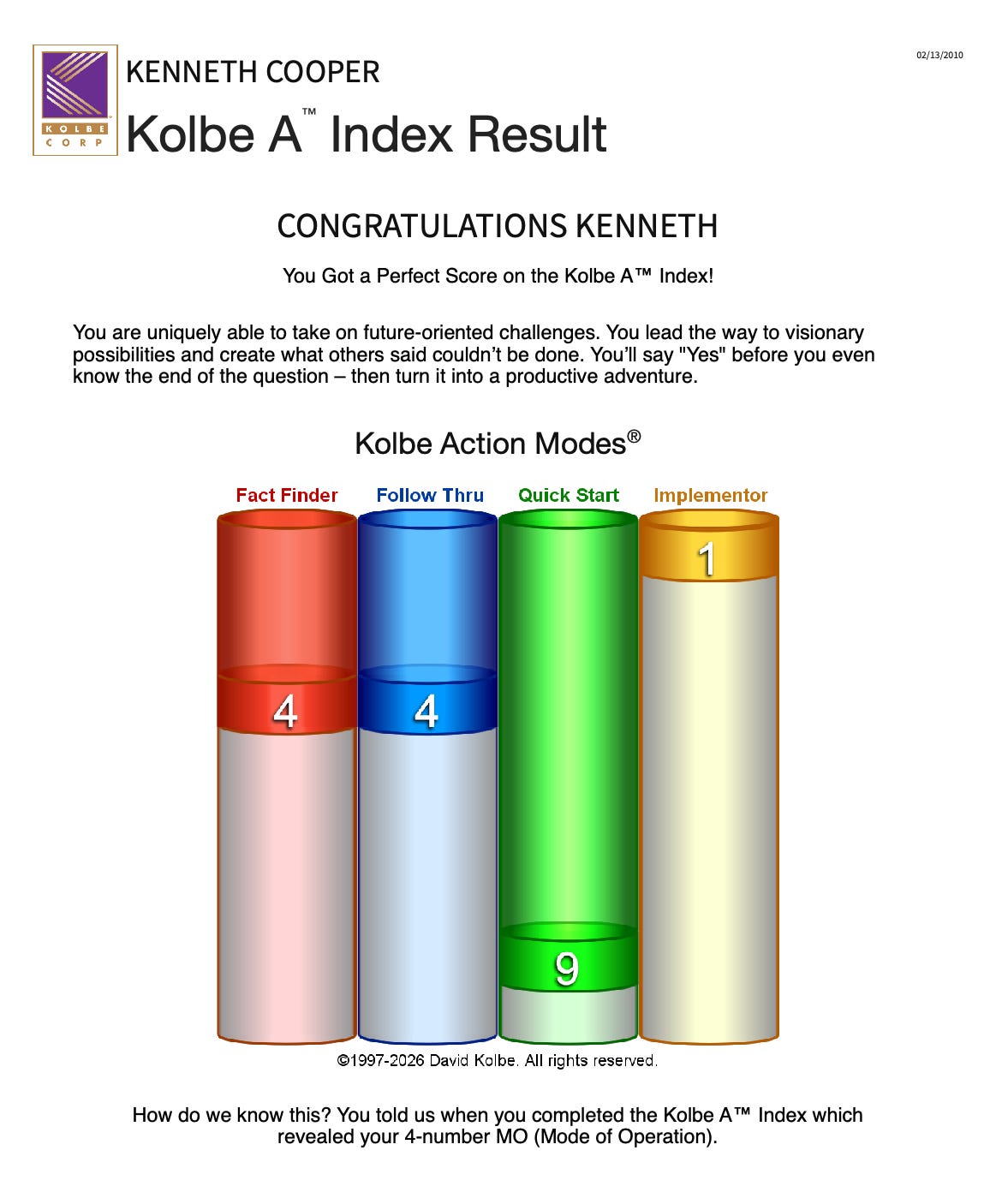
The results were stunningly accurate. They described my natural strengths rather than dividing characteristics into strengths and weaknesses.
My MO is 4-4-9-1.
That podcast changed my life because it gave me a new way to understand my natural strengths, confirming that I am a natural innovator.
I studied innovation and developed the MVP Framework, the opportunity-based personal innovation framework for high-agency individuals.
MVP stands for Mindset, Volition, and Process.
And I became a Kolbe Certified Consultant.
My Kolbe A™ Result shows that I am 4 in Follow Through. I work well with AI (and humans).
My best way of gathering and sharing information is to Explain.
This means that I gather essential facts when taking action.
My strengths include fact checking, clarifying details, adding context, and working within priorities and deadlines.
These strengths are particularly useful when working with AI (and humans).
When I work according to my strengths, I experience more alignment and energy.
You have unique natural strengths too.
Your Kolbe A™ Result will reveal them, and how you can use your natural strengths and energy to be more productive.
These strengths are unique to you, and they don’t change over time.
Taking the Kolbe A™ Index takes just 15 minutes or less and provides a lifetime of clarity about key aspects of your portable identity.
Here is the link to The Small Business Advocate podcast archive, hosted by the University of North Alabama. Search for “Kolbe” to hear the 15-minute podcast that changed my life. https://smallbusinessadvocate.com/
Message me if you’d like to learn more about the Kolbe A™ Index and your natural strengths.