


After over two decades in digital production for the comics industry, people sometimes ask me, “Who is your favorite comics character?”
Most people would typically answer with something like Batman, Spider-Man, or Superman.
Once, some friends replied “Green Arrow and Harley Quinn.” An especially unusual and very geeky choice, and if you knew them, very fitting.
My answer is a character you may not have heard of — MVP (Michael Van Patrick).
MVP’s great-grandfather was Dr. Abraham Erskine, creator of the super-soldier serum, which was used to transform Steve Rogers into Captain America.
Erskine also developed a natural diet and fitness program that could produce peak human physical development if followed over a lifetime.
MVP’s father, Brian, inherited the diet and fitness research and decided to try it out on Michael.
Perfect DNA
MVP’s super powers were simple — he didn’t have any. But thanks to his diet and fitness regimen, he ultimately possessed perfect DNA.
He excelled in all physical feats in high school, winning and setting records in every event in which he competed.
MVP was stripped of his scholarship when it was discovered that his great-grandfather was Dr. Erskine who created the super-soldier serum, even though MVP’s strength and genetics were natural.
MVP first appears in Avengers: The Initiative #1.
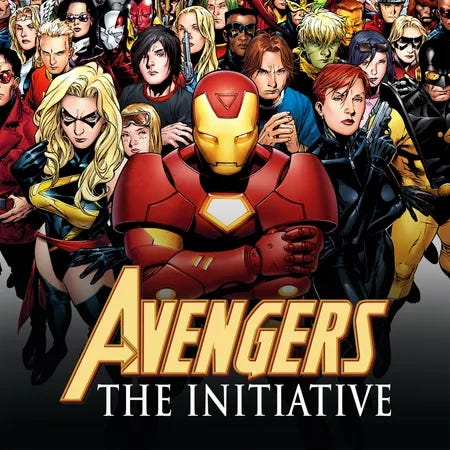
Avengers: The Initiative © Marvel. Used for commentary.
It was after the Civil War series, when the government began “The Initiative”, taking control of training and oversight of superheroes.
MVP agreed to join. Soon, others in his cohort joked, calling him “Captain America Jr.”
He excelled in training at Camp Hammond in Stamford, before losing his life while protecting fellow trainee Cloud 9 during an out-of-control training session.
Why is MVP my favorite character?
Because he had perfect DNA. Because of that fact, he was cloned several times after his death.
He also gave his life saving someone else. MVP was a true winner.
What MVP Has to Do With MVP
Here’s more about the MVP Framework and what the Marvel character MVP has to do with it:
There are three components of the MVP Framework.
MVP stands for Mindset, Volition, and Process.
Volition is key. It’s about instinct, natural strengths, and how you take action.
Kathy Kolbe’s work in conation informs the Volition aspect of the MVP Framework.
Conation differs from the cognitive dimension of the mind, such as IQ, or the affective dimension, such as personality. Conation deals with doing.
The Kolbe A™ Index takes about 12 to 15 minutes, producing your individual MO, or mode of operation.
Your MO is distinctive to you, similar to volitional DNA, and your underlying conative strengths remain stable over time.
Your MO describes how you will take action when you are free to be yourself.
Here is where the MVP character reference comes into play — when you receive your Kolbe A™ Result, at the top you will be congratulated for a perfect score.
There is no “strong” vs “weak” or “high” vs “low.” All aspects of your MO are strengths.
MVP didn’t try to become someone else. He developed what was already there.
Likewise, your perfect score demonstrates that you already possess the natural strengths you need to win.
That’s why you are an MVP.
“In a time of crisis or profound change, our instincts can anchor us. They act as a grounding point. They’re the one thing that won’t change. We can rely on them.” — Kathy Kolbe
Be Who You Already Are
The other characters being trained in the Initiative cohort were searching for identity, trying to prove themselves.
MVP was grounded in his own identity and natural strengths, freeing him to be himself, perform at his best, and ultimately, help others.
The traditional playbook tells you to make something of yourself.
The MVP playbook reminds you to be who you already are.
Something to think about…
What if the way you naturally take action isn’t something you need to fix?
What could change if you stopped comparing your strengths to someone else’s and relied on your own instincts?
Do you still feel that you need to make something of yourself in order to win?